Searching for the best ETFs to buy now can leave beginners with more questions than answers. One fund covers major US businesses. Another includes companies worldwide. Some track bonds, while others follow the price of gold.
“VOO, VTI, VXUS, BND, QQQM, and IAU are established exchange-traded products worth examining for long-term investment goals. They offer different forms of market exposure, but none is automatically suitable for every investor.
The useful starting point is simple: decide what you want your money to do before comparing funds.
This guide examines ETF choices, their differences, and the details that matter when building a long-term investment plan.
What Should You Know Before Buying an ETF?
An exchange-traded fund, or ETF, allows investors to buy shares in a portfolio through a stock exchange.
Instead of choosing several individual companies, an investor can gain exposure to a wider collection of assets through one product.
For example, a fund following a broad stock index may hold businesses from technology, healthcare, manufacturing, and other industries.
However, the value of an ETF can still fall when its underlying investments lose value.
A fund’s label does not explain everything about its risks. Its holdings, investment rules, costs, and market exposure provide a clearer picture.
The US Securities and Exchange Commission offers an official explanation of exchange-traded funds and their risks.
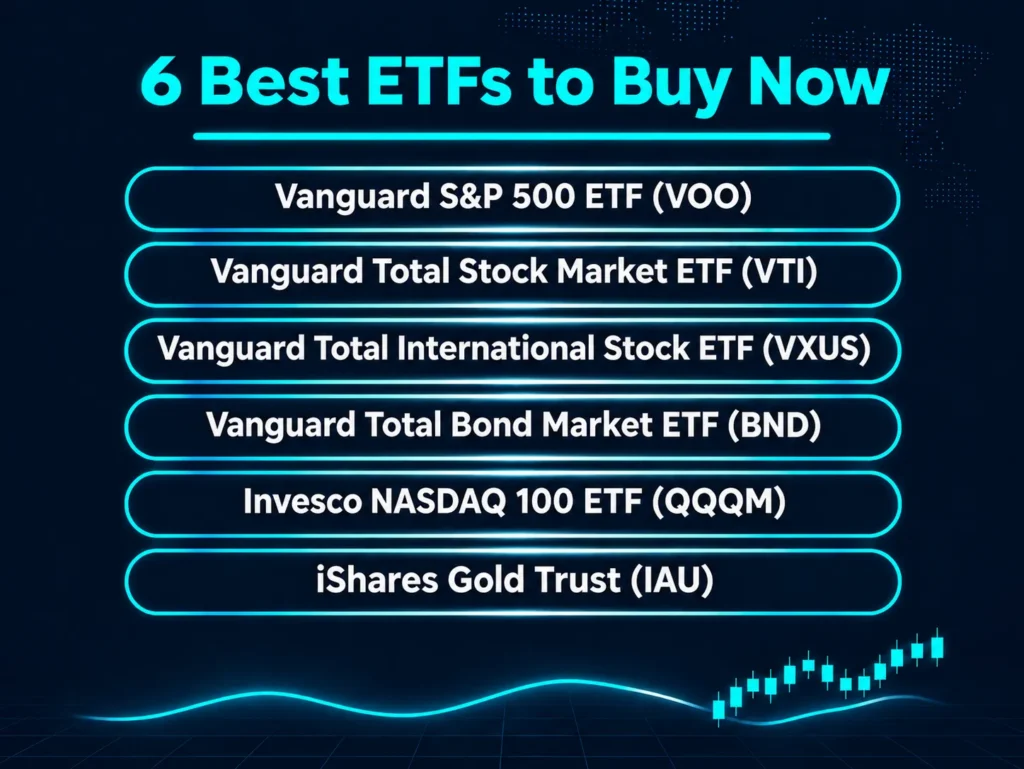
Best ETFs to Buy Now: Six Funds to Research
These established US-listed funds and exchange-traded products offer distinct ways to participate in financial markets.
They are grouped by investment exposure rather than expected performance.
| Fund | Symbol | What it offers |
| Vanguard S&P 500 ETF | VOO | Exposure to major US corporations |
| Vanguard Total Stock Market ETF | VTI | A wider selection of US companies |
| Vanguard Total International Stock ETF | VXUS | Companies outside the United States |
| Vanguard Total Bond Market ETF | BND | A portfolio of US investment-grade bonds |
| Invesco NASDAQ 100 ETF | QQQM | Exposure to large Nasdaq-listed non-financial companies |
| iShares Gold Trust | IAU | Exposure linked to physical gold prices |
1. VOO: Exposure to Established US Companies
VOO tracks the S&P 500, an index representing prominent American businesses.
Think of it as a way to follow a major part of the US corporate market without selecting each company separately.
The fund provides exposure across different industries. Still, large companies with substantial index weight can have a strong influence on its movements.
Consideration: VOO spreads investment across numerous businesses, but it remains exposed to declines in US large-company shares.
2. VTI: A Broader View of the American Market
VTI takes a wider approach than a large-company-only fund.
Its portfolio includes businesses of different sizes, giving investors exposure beyond the most familiar corporate names.
This distinction can matter when comparing how smaller and larger companies respond to changing economic conditions.
However, a broader collection of US stocks is not the same as international diversification.
Consideration: VTI reduces reliance on a narrow selection of companies but does not remove the risks of investing in US equities.
3. VXUS: Looking Beyond US Stocks
VXUS holds shares of companies located outside the United States.
Its holdings span developed and emerging economies, allowing investors to examine businesses operating under different economic conditions.
This may appeal to someone researching geographical diversification.
Yet overseas investing introduces other considerations, including local regulations, currency movements, and political developments.
Consideration: International exposure can broaden a portfolio, but foreign markets may carry risks that differ from those of domestic shares.
4. BND: Understanding the Role of Bonds
BND provides exposure to a collection of US investment-grade bonds.
When an organisation issues a bond, it is borrowing money under specified repayment and interest arrangements.
Bond funds hold many such securities rather than relying on one issuer.
Their prices respond to interest-rate movements and changes in credit conditions.
Consideration: BND offers a different asset category from stocks, but bond investments can also decline in value.
5. QQQM: A Focus on Nasdaq-Listed Businesses
QQQM follows the Nasdaq-100, which includes major non-financial companies listed on Nasdaq.
The index has substantial exposure to technology and other growth-oriented businesses.
It is useful to examine when comparing broad market coverage with a more concentrated investment approach.
A narrower focus may lead to greater sensitivity when heavily represented industries face difficulties.
Consideration: Investors should examine the largest holdings and understand how much their results influence the fund.
6. IAU: Following Gold Without Storing Bullion
IAU is a physically backed gold trust designed to reflect movements in the price of bullion, after expenses and liabilities.
It provides exchange-traded exposure to gold without requiring an investor to personally buy and store bars or coins.
Unlike a company share, gold does not produce earnings or dividends.
IAU is technically a trust rather than a conventional registered investment-company ETF.
Consideration: Its value can change sharply with the gold market, and it should not be confused with leveraged XAUUSD positions.
Which ETF Should I Buy? Start With These Questions
Instead of choosing a fund based on popularity, begin with the purpose of the investment.
Do you want broad company exposure?
Funds such as VOO and VTI illustrate different ways to follow American businesses.
Do you want geographical variety?
International funds such as VXUS provide an opportunity to examine markets outside the United States.
Do you want exposure beyond company shares?
Bond funds and gold-linked products behave differently from equity investments, although neither is free from risk.
When will you need the money?
An investment intended for a distant goal may require a different approach from money needed soon.
The right choice depends on personal circumstances rather than a universally preferred fund.
How to Compare the Best ETFs to Invest In
A shortlist becomes more useful when each product is evaluated using the same questions.
What Does the Fund Actually Own?
Read the fund’s holdings rather than relying on its name.
Two products can sound different while investing heavily in the same businesses.
For example, holding both VOO and QQQM does not necessarily provide as much diversification as their different names might suggest.
What Will It Cost to Hold and Trade?
Most funds deduct operating expenses from their assets.
Investors may also face brokerage charges and bid-ask spreads when buying or selling shares.
The bid-ask spread is the difference between the quoted buying and selling prices.
These costs matter even when a fund has a straightforward investment strategy.
Does the Investment Match Your Time Horizon?
A market decline shortly before you need your money can affect your financial plans.
Consider how long you intend to hold the investment and whether you could tolerate a temporary or prolonged fall in its value.
Can You Explain the Main Risk?
Before investing, try describing in plain language what could cause the fund to lose value.
If the answer is unclear, examine the prospectus and holdings more carefully.
ETFs vs Forex and Gold Trading: Important Differences
ETF investing and short-term market trading are not interchangeable.
An ordinary ETF investor holds shares of an exchange-traded product. A retail forex or gold CFD trader generally enters a contract based on the movement of an underlying price.
These arrangements involve different ownership, financing, margin, and execution considerations.
Some ETFs are also leveraged or derivative-based, so investors should not assume all exchange-traded products work alike.
Readers familiar with futures trading strategies should pay particular attention to the differences between owning ETF shares and trading contracts with expiry or margin requirements.
Understanding the product structure is as important as understanding price movements.
Risks Beginners Often Overlook
A fund containing numerous investments can still experience substantial losses.
Here are several less obvious issues.
- Overlapping holdings: Buying multiple ETFs may unintentionally increase exposure to the same businesses.
- Market concentration: A fund can contain many companies yet remain strongly influenced by a few dominant holdings.
- Currency exposure: Foreign investments can change in value when exchange rates move.
- Interest-rate sensitivity: Bond prices may fall as market interest rates rise.
- Trading-price differences: ETF shares can trade at prices above or below the value of their underlying assets.
- Unexpected costs: Fund expenses and transaction charges can affect long-term outcomes.
The SEC’s investor bulletin on fund fees explains why comparing investment costs matters.
A Practical Way to Begin ETF Research
You do not need to examine every available ETF at once.
Begin with a small group of funds that represent different types of exposure.
Read their official documents and identify their largest holdings.
Compare how each fund operates, what costs apply, and which market developments could affect its value.
Next, consider whether the investment fits your financial needs and capacity for losses.
For readers who also follow active markets, understanding position sizing in forex and gold illustrates the broader importance of controlling financial exposure.
The calculations for leveraged trading differ from ordinary ETF investing, but the principle of understanding risk before entering a position remains relevant.
Conclusion
Finding the best ETFs to buy now is less about identifying a winning ticker and more about understanding what each investment contributes.
VOO and VTI offer different approaches to US equities. VXUS adds international market exposure, BND focuses on bonds, QQQM follows a more concentrated stock index, and IAU provides gold-linked exposure.
Every option carries risks, and none guarantees future returns.
For readers interested in financial markets beyond ETFs, Daily Forex Trades publishes educational material covering forex, gold, trading methods, and market risk.
Risk Disclaimer: ETF investing involves the possibility of losing capital. Fund prices may decline due to market conditions, asset concentration, currency movements, and other factors. Leveraged trading introduces additional risks. This article is for educational purposes only and is not personalised investment advice.
FAQs
Established options to research include VOO, VTI, VXUS, BND, QQQM, and IAU. Their suitability depends on the type of exposure and risks an investor wants to evaluate.
Broad index-tracking funds can be easier to research because their holdings and investment objectives are generally well documented.
No. VOO follows major US companies in the S&P 500, while VTI covers a wider range of American businesses.
Some funds contain many different investments, but diversification depends on how those holdings are distributed.
No. Exchange-traded products can provide exposure to bonds, commodities, currencies, and other assets.
Not necessarily. A gold-linked trust and a leveraged XAUUSD contract have different structures, costs, and risks.
Yes. A fund can experience substantial declines when the assets it holds fall in value.
Yes. Operating expenses and trading charges can reduce the amount an investor ultimately retains.
That depends on the holdings. Several funds may provide broader exposure, or they may duplicate investments already owned.
Historical results can provide context, but they cannot establish how an ETF will perform in the future.