

Many beginners enter forex with one big question: how much forex trading profit per day can I make? Some people expect quick income, while others hear stories about traders making $100, $500, or even more daily. The truth is more realistic.
Yes, you can make money trading forex, but it takes education, practice, discipline, and strong risk management. Forex is not a guaranteed daily income machine. It is a skill-based financial market where profits and losses both happen.
In this guide, you will learn how forex trading works, what daily profits are realistic, which strategies beginners can use, and how to protect your account while building long-term trading confidence.
A realistic forex trading profit per day depends on account size, risk level, strategy, and experience. Beginners should focus on small consistent growth, such as 0.5% to 2% per trade setup, instead of chasing fixed daily income
What Is Forex Trading?
Forex trading is the buying and selling of currencies to profit from price changes. Forex stands for foreign exchange.
For example, if you trade EUR/USD, you are trading the euro against the U.S. dollar. If you buy EUR/USD, you expect the euro to rise. If you sell EUR/USD, you expect the euro to fall.
Forex trading is popular because the market is open 24 hours a day, five days a week. Traders can use different styles such as scalping, day trading, swing trading, and position trading.
However, forex trading for beginners should always start with learning the basics before risking real money.
Can You Really Make Money Trading Forex?
Yes, traders can make money trading forex, but not every trader becomes profitable. Success depends on knowledge, patience, emotional control, and a tested strategy.
Many beginners lose money because they trade without a plan, use high leverage, or follow random signals without understanding risk.
To become profitable, traders need:
- A clear forex trading strategy
- Proper risk management
- Realistic profit expectations
- Trading discipline
- A journal to track results
- Practice on a demo account
- Emotional control during wins and losses
So, can you make money with forex? Yes. But it should be treated like a professional skill, not a quick passive income shortcut.
How Much Forex Trading Profit Per Day Is Realistic?
The most honest answer is: it depends on your capital, strategy, and risk.
A trader with a $100 account should not expect the same forex trading income as a trader with a $10,000 account. Percentage return matters more than dollar amount.
Example of Realistic Daily Expectations
Account Size | 1% Daily Gain | 2% Daily Gain |
$100 | $1 | $2 |
$500 | $5 | $10 |
$1,000 | $10 | $20 |
$5,000 | $50 | $100 |
$10,000 | $100 | $200 |
This table shows why account size matters. Making $100 per day from a $100 account is unrealistic and extremely risky. But making $100 from a $10,000 account is more reasonable if the trader has skill and discipline.
Still, no trader wins every day. Some days bring losses. That is why realistic forex profits should be measured weekly or monthly, not only daily.
Factors That Affect Forex Trading Income
Your forex trading income depends on several important factors.
Account Size
A larger account can generate larger dollar profits with the same percentage return. However, bigger accounts also require stronger discipline.
Risk Per Trade
Most careful traders risk only 1% to 2% per trade. High risk can grow an account quickly, but it can also destroy it quickly.
Leverage
Leverage allows traders to control larger positions with smaller capital. However, leverage increases both profits and losses. Beginners should use low leverage until they understand market behavior.
Strategy Quality
Profitable forex trading strategies are based on clear rules, not random guessing. A strategy should define entry, exit, stop loss, and take profit.
Trading Psychology
Fear, greed, revenge trading, and impatience can damage even a good strategy.
Best Forex Trading Strategies for Beginners
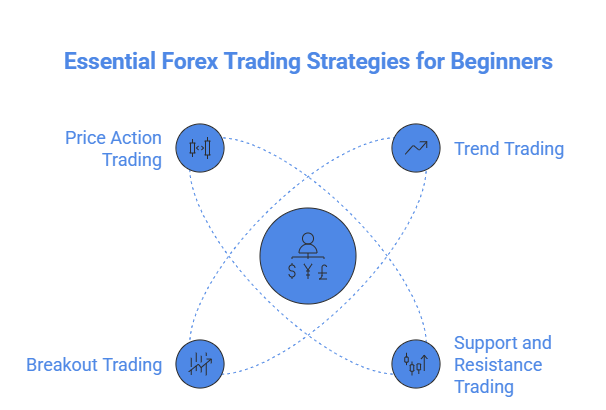
New traders should also learn the best forex pairs for beginners because low-spread and liquid pairs can make trading easier to manage.
1. Trend Trading
Trend trading means following the market direction. If EUR/USD is making higher highs and higher lows, traders may look for buy setups.
2. Support and Resistance Trading
This strategy focuses on key price levels where the market may bounce or reject.
3. Breakout Trading
A breakout happens when price moves above resistance or below support with strength.
4. Price Action Trading
Price action uses candlesticks, market structure, and clean charts to understand buyer and seller behavior.
These are some of the best forex trading strategies for beginners because they teach market logic instead of relying only on indicators.
Forex Day Trading Strategy Explained
A forex day trading strategy involves opening and closing trades within the same day. Traders avoid holding positions overnight.
Day traders often use:
- 15-minute, 30-minute, and 1-hour charts
- London and New York sessions
- Support and resistance
- Trend confirmation
- Risk-to-reward planning
Example:
A trader sees GBP/USD breaking above resistance during the London session. They enter a buy trade, place stop loss below the breakout area, and target the next resistance zone.
Day trading is popular because it offers regular opportunities without overnight risk.
Forex Scalping Strategy for Fast Profits
A forex scalping strategy focuses on small, fast trades. Scalpers may hold trades for seconds or minutes and aim for small pip profits.
Scalping can work in low-spread pairs such as EUR/USD, but it is not easy for beginners. It requires fast decisions, strong focus, and strict discipline.
Scalping is best when:
- Spreads are low
- Market liquidity is high
- Execution is fast
- The trader avoids emotional entries
- Stop loss is used on every trade
Beginners should practice scalping on demo first before using real money.
Importance of Forex Risk Management
Forex risk management is the foundation of long-term trading success. A trader can have a good strategy and still lose money without risk control.
Important rules include:
- Risk only 1% to 2% per trade
- Use stop loss every time
- Avoid over-leveraging
- Do not increase lot size after losses
- Use a realistic risk-to-reward ratio
- Stop trading when emotional
- Never risk money needed for living expenses
A common beginner goal is to protect capital first and grow profits second.
Common Mistakes Beginner Traders Make
Many beginners fail because they focus only on profit and ignore process.
Avoid these mistakes:
- Chasing unrealistic daily income
- Trading without a plan
- Overtrading after a loss
- Using high leverage
- Ignoring stop loss
- Copying signals blindly: Before following any signal, beginners should understand how Forex Trading Signals work and why risk management matters.
- Trading during major news without experience
- Changing strategy too often
The best traders are not always the ones who trade the most. They are often the ones who wait for quality setups.
Realistic Forex Trading Success Rate
The forex trading success rate is different for every trader. Many beginners struggle because they enter the market without training, risk control, or emotional discipline.
A realistic view is this: most traders need months of learning and practice before they become consistent. Some may take longer.
Success usually comes from:
- Testing one strategy
- Keeping risk small
- Reviewing mistakes
- Building emotional control
- Learning from market behavior
- Staying consistent during losing periods
Forex trading is a long-term skill. It rewards patience more than excitement.
Best Forex Trading Strategy 2026
The best forex trading strategy 2026 is not a secret indicator or magic signal. For most beginners, the best strategy is a simple plan that combines trend direction, support and resistance, price action, and risk management.
A beginner-friendly strategy may look like this:
- Identify the trend on the 1-hour chart.
- Mark support and resistance levels.
- Wait for price to pull back.
- Confirm with a candlestick signal.
- Enter with a stop loss.
- Target at least a 1:2 risk-to-reward ratio.
- Record the result in a trading journal.
Simple strategies are easier to follow, easier to improve, and safer for beginners.
Tips to Become a Consistently Profitable Forex Trader
To build realistic forex profits, focus on consistency.
Helpful tips include:
- Learn before you earn
- Practice on demo first
- Start with small live trades
- Focus on one or two currency pairs
- Avoid emotional trading
- Use a trading journal
- Accept losses as part of trading
- Review weekly performance
- Keep risk small
- Study forex trading strategies regularly
Consistency comes from repeating good decisions, not from forcing trades every day.
To build better habits, read our guide on Best Practices for New Forex Traders before moving from demo trading to a live account.
Conclusion
So, how much forex trading profit per day can you make? The answer depends on your account size, risk level, strategy, and experience. While it is possible to make money trading forex, beginners should avoid unrealistic expectations and focus on learning first.
Forex trading can create opportunities, but it also carries real risk. The traders who last are the ones who manage risk, follow a strategy, control emotions, and continue improving.
If you are new to trading, start with education, practice on a demo account, learn responsible forex trading strategies, and build your skills step by step with Daily Forex Trades.
FAQs
You can make money trading forex on some days, but daily profit is never guaranteed. Market conditions change, and even professional traders have losing days.
A realistic forex trading profit per day depends on account size and risk. Beginners should focus on percentage growth and risk control instead of fixed daily income.
With a $100 account, realistic profits are small. For example, a 1% gain equals $1. Trying to make large daily profits from a small account usually requires dangerous risk.
Trend trading, support and resistance, and price action strategies are often best for beginners because they are easier to understand and manage.
Forex scalping can be difficult for beginners because it requires fast decisions and strict discipline. New traders should practice scalping on demo before live trading.