

Imagine finding a promising EUR/USD trade, setting your stop loss, and then wondering whether to open 0.10 lots or 1.00 lot. That choice can make a major difference to your account.
A Lot Size Calculator solves this problem by estimating trade volume from the amount you are prepared to lose if the market moves against your position.
Forex and gold traders can use it to match their position size with their planned risk instead of choosing lots at random.
This approach supports disciplined trading and works alongside other forex risk management tools.
Here is how the calculation works, why gold needs special attention, and what beginners should check before entering a trade.
What Is a Lot Size Calculator?
A Lot Size Calculator is a position-planning tool that converts a trader’s risk limit into a trading volume.
The result is usually expressed in lots, a unit used to describe the size of a trading position.
In the forex market, common lot sizes are:
-
- Standard lot: 100,000 units of the base currency.
-
- Mini lot: 10,000 units.
-
- Micro lot: 1,000 units.
A standard EUR/USD lot, for instance, represents 100,000 euros.
Gold uses different contract rules. Many brokers define a standard XAUUSD lot as 100 troy ounces, but specifications can differ.
That is why a reliable Forex Lot Size Calculator must account for the instrument being traded.
How Does a Forex Lot Size Calculator Work?
Instead of starting with the desired trade volume, begin with the amount you can afford to put at risk.
A calculator then considers how far the market must move before reaching your stop loss.
Information Required for a Lot Size Calculator
The essential inputs include:
Account value: Your available balance or equity, depending on your risk plan.
Planned risk: The amount you are willing to lose on the trade.
Entry and stop-loss prices: These establish the distance between the planned entry and exit.
Instrument value: The relevant pip value or contract specification.
Account currency: This affects how trading losses are converted into the currency of your account.
According to CME Group’s guide on proper position sizing, traders should consider their stop-loss distance and acceptable risk before choosing a lot size.
Remember that the calculation assumes the stop loss executes as expected. Real market conditions may produce a different result.
How to Calculate Lot Size in Forex
You can understand the calculation without using complex mathematics.
The basic formula is:
Lot Size = Planned Risk ÷ (Stop-Loss Distance × Value per Lot)
The value per lot must match the distance unit used in the calculation.
Forex Lot Size Calculator Example: EUR/USD
Suppose a trader has a USD account and wants to examine this hypothetical setup:
-
- Planned risk: $30
-
- Stop-loss distance: 30 pips
-
- Pip value for a standard lot: $10
A standard lot would lose approximately $300 if the price moved 30 pips against the trade, excluding extra costs.
Dividing the $30 planned risk by $300 gives:
Position size = 0.10 lots
This calculation helps the trader assess whether the intended position matches their risk limit.
It is particularly relevant when applying a forex trading strategy for small accounts.
The same lot size may be unsuitable for a different currency pair, stop-loss distance, or account currency.
How to Use a Lot Size Calculator for Gold
Gold requires a different calculation because XAUUSD prices are commonly quoted in US dollars per troy ounce.
A change of $1 in the gold price has a different monetary effect depending on the number of ounces traded.
Gold Lot Size Calculator Example: XAUUSD
Consider a hypothetical gold trade using these details:
-
- Planned risk: $25
-
- Entry price: $3,000 per ounce
-
- Stop-loss price: $2,995 per ounce
-
- Standard contract size: 100 ounces
The price difference is $5 per ounce.
For one standard lot, the calculated loss would be:
$5 × 100 ounces = $500
To estimate the position size:
$25 ÷ $500 = 0.05 lots
Under these assumptions, 0.05 lots would carry approximately $25 in price-based risk before additional trading costs.
Anyone using gold trading signals should still calculate a position size appropriate to their own account.
Why Position Size Matters More Than Trading Volume
A large position is not automatically a better position.
A Forex Position Size Calculator encourages traders to judge a setup by its potential loss rather than the amount they hope to earn.
Maintain Consistent Risk
Different trades may require different volumes.
If one setup needs a wide stop loss and another needs a narrow stop, using identical lot sizes can expose the account to very different losses.
Understand Gold Market Conditions
XAUUSD prices can respond sharply to economic announcements and changing market expectations.
The discussion of gold seasonality and trading conditions provides useful context, although historical trends cannot predict individual outcomes.
Avoid Emotional Position Sizing
Traders sometimes increase their position after losing money or reduce their stop-loss distance simply to trade a larger lot.
A Trading Lot Size Calculator helps bring the decision back to a predefined risk plan.
Common Mistakes When Calculating Lot Size
Position sizing becomes less useful when the trader enters incorrect information.
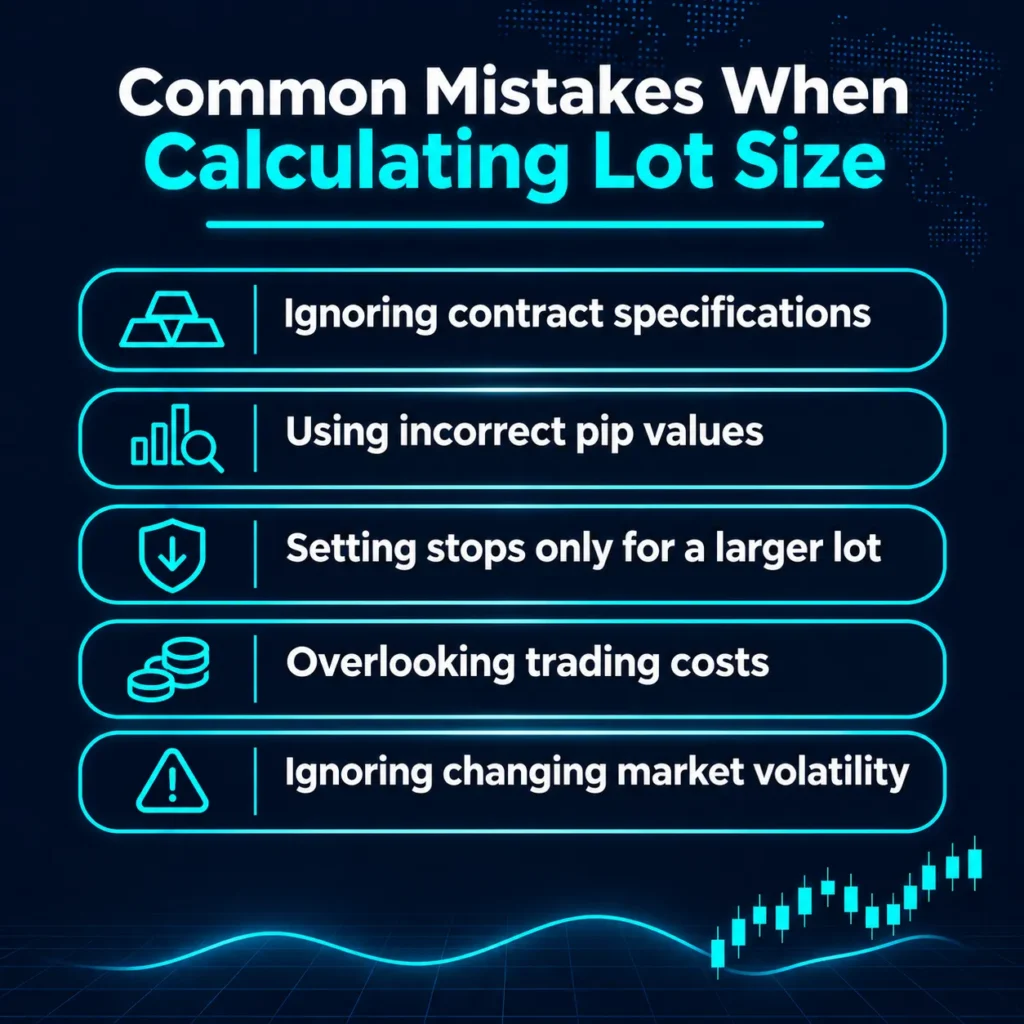
Confusing points and pips: Some platforms display price changes differently. Check the unit used by the calculator.
Assuming every gold lot is identical: Contract sizes must be confirmed with the broker.
Ignoring account currency: Pip values and potential losses may need conversion.
Leaving out trading costs: Commissions, spreads, and slippage can increase the loss.
Confusing margin with risk: Having enough margin to open a position does not mean its potential loss is acceptable.
These errors can affect even experienced traders, particularly when switching between forex pairs and precious metals.
Lot Size Calculator vs Position Size Calculator
A Lot Size Calculator and Position Size Calculator usually serve the same core purpose: estimating trade volume from planned risk.
The difference is often how results are displayed.
A Forex Position Size Calculator may show currency units alongside lots. A dedicated forex trade calculator might also include margin, profit-and-loss estimates, and transaction costs.
Margin calculations should not replace risk calculations.
Leverage changes the funds needed to support a position, but the price movement and position quantity determine its basic market exposure.
Conclusion
A Lot Size Calculator gives forex and gold traders a structured way to decide how much to trade before opening a position.
By combining planned risk, stop-loss distance, and the correct instrument value, traders can make more consistent sizing decisions.
The same principles remain relevant when reviewing forex trading signals or evaluating trade ideas through DailyForexTrades.
Choosing an appropriate lot size does not guarantee a successful trade, but it makes potential exposure easier to understand.
FAQs
It estimates how much of an instrument to trade based on a chosen risk amount, stop-loss distance, and contract or pip value.
Beginners can choose a risk limit, identify a stop-loss level, and enter the required details into a Forex Risk Calculator. The result should be checked against the broker's instrument specifications.
Yes, provided it supports XAUUSD and uses the correct gold contract size. Forex pip calculations should not be applied to gold without checking the instrument's price conventions.
Position-size calculations focus on potential price-based losses. Margin requirements depend on leverage and are usually calculated separately.
No. It can help plan exposure, but unexpected price gaps, slippage, and other market conditions may cause losses beyond the intended amount.
There is no single safest lot size for every trader. Beginners should choose their position size based on account balance, stop-loss distance, and acceptable risk rather than using a fixed lot size.
In forex, 0.01 standard lot usually represents 1,000 units of the base currency. For XAUUSD, 0.01 lot typically represents one troy ounce when the broker defines one standard lot as 100 ounces.
Yes. A wider stop loss generally requires a smaller lot size to maintain the same planned risk. A tighter stop loss may allow a larger position, but it should reflect market conditions.
You can calculate trading volume, but estimating the potential loss becomes difficult without a defined exit level. A stop loss helps a Forex Risk Calculator estimate how much capital is exposed.
Differences may result from contract sizes, pip values, account currency conversions, or minimum trading volumes. Always verify your broker's instrument specifications before placing a trade.