

Futures trading strategies are sets of rules that help traders decide when to enter a futures contract, when to exit, and how much capital to risk. Common approaches include trend following, breakout trading, price action, scalping, and range trading.
The best approach depends on market conditions, trading experience, and risk tolerance. No single strategy works in every market.
Beginners can start by understanding contract specifications, studying price movements, and developing a trading plan.
Many principles also appear in forex risk management tools, although futures contracts have their own margin and settlement rules.
This guide explains practical futures setups and the risks traders should consider before placing an order.
What Are Futures Trading Strategies?
A futures trading strategy provides a structured method for buying or selling a futures contract.
A futures contract is an agreement traded under standardised exchange rules, typically linked to an asset such as gold, oil, a stock index, or a currency.
Traders may use futures to speculate on price movements or hedge existing exposure.
The CFTC’s futures trading basics explain how these markets operate and why participants use them.
Unlike spot forex or many gold CFDs, exchange-traded futures have defined contract specifications and expiry arrangements. Margin requirements and settlement procedures also differ.
5 Best Futures Trading Strategies to Understand
These approaches offer different ways to interpret market movements. They are examples for comparison, not a performance ranking.
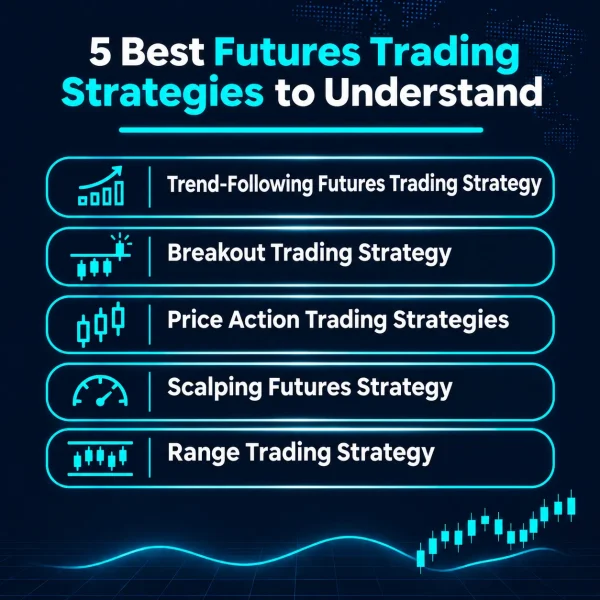
1. Trend-Following Futures Trading Strategy
Trend following attempts to trade in the direction of an established market movement.
Traders look for higher highs and higher lows during an uptrend, or lower highs and lower lows during a downtrend.
Moving averages can help identify the broader direction.
Example: Gold futures maintain an upward trend. A trader watches for a pullback toward support before considering a long position.
Main risk: A trend can reverse suddenly, while sideways conditions may produce repeated false signals.
2. Breakout Trading Strategy
A breakout occurs when the market moves beyond a previously established trading range.
Traders identify clear support and resistance levels, then observe whether price moves outside those boundaries.
Example: An index future trades within a narrow range. Price rises above resistance, prompting traders to assess a possible buying opportunity.
A breakout can fail when price quickly returns inside the range.
Waiting for a candle close or a retest may provide additional context, but neither confirms that the breakout will continue.
3. Price Action Trading Strategies
Price action trading studies price movements without relying heavily on technical indicators.
Traders analyse candlestick formations, swing points, and support and resistance zones.
A rejection candle near support may suggest renewed buying interest, while a failed breakout may suggest weakening momentum.
These ideas are related to forex candlestick patterns and price behaviour.
Main risk: Chart interpretation can be subjective, and similar patterns may lead to different outcomes.
4. Scalping Futures Strategy
Scalping involves opening and closing positions within short periods to capture relatively small price movements.
Scalpers closely monitor spreads, liquidity, order execution, and transaction costs.
The approach demands attention because prices can change quickly.
A trader may consider a short-term entry after a brief pullback in an active market.
However, slippage and frequent commissions can increase costs substantially.
Scalping should not be confused with an easy or low-risk trading method.
5. Range Trading Strategy
Range trading focuses on markets moving between identifiable support and resistance levels.
Traders observe potential buying opportunities near support and selling opportunities near resistance.
Example: A currency futures contract repeatedly moves between two price levels without establishing a clear trend.
The trader may wait for a price reaction near one boundary.
Main risk: A strong breakout can invalidate the range and produce losses.
How to Choose Futures Trading Strategies for Beginners
Futures trading for beginners starts with understanding the market rather than searching for a guaranteed winning setup.
Match the Strategy to Market Conditions
Trend-following methods suit markets showing a sustained direction.
Range strategies examine sideways conditions, while breakout traders focus on price movements beyond established boundaries.
A method that appears suitable today may become less effective when market behaviour changes.
Understand Contract Specifications
Before opening a trade, check the contract’s tick size, tick value, expiry date, and margin requirements.
Tick size is the smallest permitted price movement for a contract. Tick value is the monetary value of that movement.
Gold futures, currency futures, and equity index futures can have very different specifications.
Test the Trading Rules
Define entry conditions, stop-loss placement, and exit criteria before trading.
A simulated account can help traders become familiar with order placement and strategy execution.
However, simulated trading cannot fully reproduce live-market pressure or execution conditions.
Day Trading Futures Strategies: Managing Risk
Day trading futures strategies involve opening and closing positions within the same trading day.
This reduces overnight exposure when all positions are closed, but it does not eliminate intraday losses.
A practical risk plan should include:
-
- A clear entry and exit rule.
-
- A stop-loss level based on the setup.
-
- Position sizing using the contract’s tick value.
-
- An acceptable loss limit.
-
- Awareness of scheduled economic announcements.
The CFTC advises traders to understand the risks and financial obligations of futures trading before committing capital. Its futures trading risk checklist offers useful questions to consider.
Risk management is also important when adapting small-account trading strategies to different markets.
Common Futures Trading Mistakes
Even a well-defined strategy can fail when traders overlook basic trading conditions.
-
- Trading without a plan: Entries based on excitement or fear can lead to inconsistent decisions.
-
- Ignoring contract expiry: Futures positions may require closing or rolling before expiry.
-
- Using excessive leverage: Relatively small price changes can cause substantial account losses.
-
- Overtrading: Taking repeated trades without valid setups can increase costs.
-
- Relying only on backtests: Historical results cannot predict future market behaviour.
A trader’s decision-making also benefits from understanding the best practices for new forex traders, particularly discipline and risk awareness.
Conclusion
The best futures trading strategies are those traders understand, can apply consistently, and can manage within their financial limits.
Trend following, breakouts, price action, scalping, and range trading offer different approaches to market analysis. Each has limitations and requires careful risk planning.
Although futures and spot markets have different trading mechanics, DailyForexTrades’ gold trading signals and market analysis can provide additional context for evaluating gold price movements.
FAQs
Trend following, breakout trading, and basic price action are useful starting points for study. Beginners should understand contract risks and practise before trading with real money.
Yes. Many futures contracts support intraday trading. However, liquidity, volatility, fees, and margin requirements vary by contract and trading session.
Some chart-based methods apply to both markets. However, futures traders must account for contract expiry, tick values, exchange rules, and different margin arrangements.
Yes. Rapid price changes, leverage, slippage, and frequent transaction costs can make scalping challenging.
No. Every strategy can produce losses. Market changes, incorrect analysis, and execution problems can affect outcomes.
The amount needed depends on the futures contract, broker margin requirements, and trading strategy. Beginners should also maintain enough funds to manage potential losses and avoid using money they cannot afford to lose.
Futures trading involves standardised contracts traded on exchanges with defined expiration dates. Spot forex trading involves exchanging currencies through a decentralised market. Both involve price fluctuations, leverage, and financial risk.
Moving averages, Relative Strength Index (RSI), MACD, and Volume Weighted Average Price (VWAP) are commonly used in futures trading. The most suitable indicator depends on the strategy, market conditions, and trading timeframe.
Futures day traders often analyse shorter timeframes, such as 5-minute or 15-minute charts, while using higher timeframes to assess market direction. The right timeframe depends on the contract's liquidity, volatility, and trading approach.
Yes. Beginners can explore automated futures trading systems that execute trades using predefined rules. However, automation does not eliminate losses, and traders should test their strategies, monitor performance, and maintain risk controls.