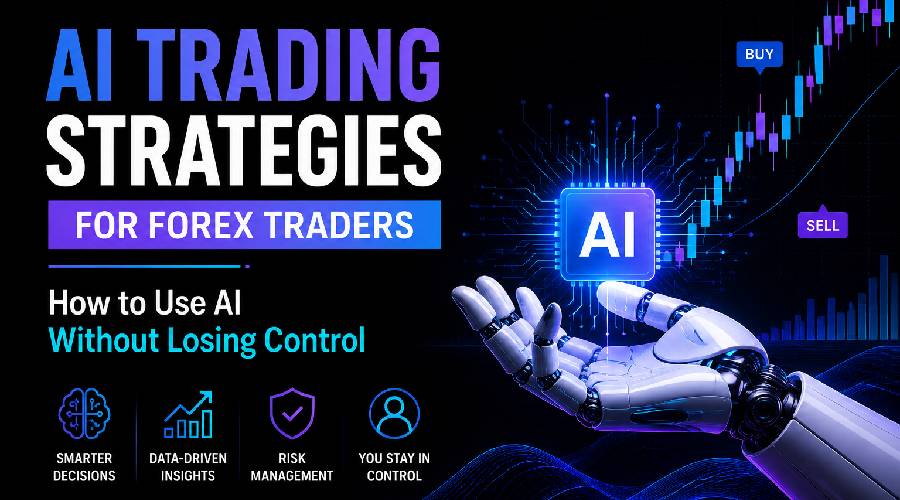
Artificial Intelligence (AI) is kind of reshaping how people trade forex, and in 2026 the whole thing looks even faster. AI powered tools can analyze market data, find possible trading openings, and also generate trade signals within seconds. What used to take hours of chart staring and careful notes, can now be handled automatically by advanced algorithms, sometimes with less effort.
Because of that, more traders are taking up AI forex trading tools to boost efficiency and make sharper choices. Still, a common trap is thinking AI can guarantee profits, like it’s some kind of sure bet. In reality, no technology can fully erase risk in the forex market, not even the newest models.
The traders who usually do better treat AI as a sort of support device, not a total replacement for their own thinking. In this guide you’ll see how AI trading strategies work, how to use them properly, and how to keep control over your own trading decisions.
What Is AI Trading in Forex?
AI trading is basically the use of artificial intelligence along with machine learning technologies to analyze market data and help with trading decisions.
Instead of traditional indicators that stick to rigid rules, AI systems can take in massive amounts of information and adjust when market conditions shift. These tools can study past price movement, economic updates, news reactions, and market mood, in order to spot trading opportunities that may not be obvious at first glance.
Common Uses of AI in Forex Trading
- Market trend analysis
- Trade signal generation
- Pattern recognition
- Sentiment analysis
- Risk management support
- Automated trade execution
Modern AI trading systems can watch multiple currency pairs at the same time, which helps traders see opportunities that might otherwise slip by, even when you think you’re already looking carefully.
Why Forex Traders Are Turning to AI in 2026
Forex is moving, like really quickly. There are trillions of dollars going through it every day, so sometimes opportunities show up , then vanish within minutes.
That’s where AI comes in, because it can help traders stay in the loop in this rapid, almost relentless environment.
Faster market analysis (yeah it matters)
A major edge AI forex trading brings is speed. These systems can sift through thousands of data points nearly instantly.
Instead of someone manually flipping through charts , traders get practical takeaways in real time.
Decision making that’s not dragged by feelings
Fear and greed are, honestly, some of the most common reasons traders end up losing money.
AI trading tools use rule based logic from the data, without being pushed around by emotions. So it keeps things steadier and more disciplined.
Market monitoring 24/7 (no breaks)
The forex market keeps running around the clock across the trading week.
AI tools can watch conditions nonstop, even if traders are asleep or just not in front of the screen.
Reading market data, in a better way.
AI is able to handle complicated signals from things like:
- Economic calendars
- Central bank remarks
- Inflation reports
- Job numbers / employment data
- Financial news
So traders can respond faster when the market shifts.
The Biggest Mistake Traders Make With AI
A lot of traders think AI could just replace human decision making entirely, like it’s a total swap. Honestly that sounds tempting, but it’s also a risky belief.
This is a dangerous assumption, a really dangerous one
AI Is Not a crystal ball
Even the most advanced AI trading software can’t truly see the future with perfect precision.
Markets get pulled around by all kinds of weird stuff like, for example:
- Political developments
- Natural disasters
- Geopolitical conflicts
- Economic surprises
Those things can trigger abrupt price swings, and no AI system fully, I mean completely, anticipates them ahead of time.
Blindly Following AI signals
Some traders open positions only because an AI tool told them to, no extra questions.
That tends to end in losses, mainly because they don’t bother to understand why the trade was suggested in the first place. Not the usual explanation, but the real logic behind it.
AI should help you navigate, not decide for you, like a pilot that never lets you touch the controls
Ignoring Risk management
No strategy stays profitable 100% of the time.
Even strong AI trading signals can still get it wrong. So risk management is not optional, and using effective risk management tools is still essential.
The best traders usually mix AI insights with strict discipline and a careful plan, they don’t just chase a recommendation
Top AI Trading Strategies for Forex Traders
1. AI-Powered Trend Following Strategy
Trend-following remains one of the most reliable forex trading strategies.
AI systems analyze:
- Price action
- Volume data
- Moving averages
- Historical trends
These tools can identify emerging trends earlier than traditional indicators.
Many traders use AI trend analysis to confirm whether a market is bullish, bearish, or ranging before entering a trade.
2. AI-Based Sentiment Trading
Market sentiment plays a major role in currency price movements.
AI sentiment analysis tools scan:
- News articles
- Financial publications
- Social media discussions
- Economic announcements
The system then determines whether overall market sentiment is positive or negative.
This information helps traders anticipate potential price movements before they occur.
3. AI-Assisted Breakout Trading
Breakout strategies aim to capture strong price movements when support or resistance levels are broken.
AI can identify:
- Key price levels
- Breakout probability
- Volume confirmation
- Market momentum
This helps traders avoid false breakouts and improve trade timing.
4. AI Scalping Strategies
Scalping involves making multiple small trades throughout the day.
Because scalping requires quick decision-making, AI tools can be especially useful.
AI systems can:
- Detect short-term opportunities
- Analyze market momentum
- Monitor multiple charts simultaneously
However, traders should carefully manage costs and spreads when using scalping strategies.
5. AI Risk Management Strategy
One of the most valuable applications of AI is risk management.
Advanced AI trading systems can recommend:
- Position sizes
- Stop-loss levels
- Take-profit targets
- Portfolio exposure limits
This helps traders protect capital while maximizing opportunities.
Top AI Trading Strategies for Forex Traders
AI powered trend following, still sort of feels like one of the more dependable forex strategy options.
Most systems that use AI will look at things like, price action, volume figures, moving averages and even longer historical trend patterns. Then they can spot a new trend earlier than a bunch of standard indicators would usually show it. A lot of traders also lean on ai trend analysis as a rough sort of confirmation, like deciding if the market is bullish, bearish, or just moving sideways before they actually pull the trigger.
AI based sentiment trading is another angle, because the overall mood of the market can really steer currency prices.
With sentiment analysis tools, the system scans news articles, financial publications, social media chatter, and economic announcements. After that, it tries to judge whether the collective sentiment is overall positive or negative. The goal is pretty straightforward: help traders anticipate potential price movement before it shows up on the chart, not after, or at least not as late.
Then there’s AI assisted breakout trading, where the whole idea is to catch strong movement when support or resistance gets broken.
In practice, AI may highlight key price levels, estimate breakout likelihood, check for volume confirmation and measure market momentum. This can reduce the chance of getting trapped by false breakouts, and it also tends to improve entry timing, because the system is not just eyeballing candles.
For traders who like faster pace, AI scalping strategies can be compelling.
Scalping means many small trades across the day. Since it needs quick decisions, AI tools can be handy in a kind of constant watch mode. They can, for example, spot short term opportunities, track momentum shifts, and monitor multiple charts at the same time. Still, it’s important to manage costs and spreads, because those tiny edges can get eaten up pretty fast.
Finally, there is AI risk management, which might be the most useful part overall.
More advanced AI trading systems can suggest position sizes, stop loss placement, take profit targets, portfolio exposure limits, and analyze forex trading signals in real time. So traders can protect capital while also trying to keep room for opportunity, without taking random risks just because the market looked “tempting” in the moment.
How to Use AI Without Losing Control
The goal isn’t to let AI trade for you blindly, or well, just “set it and forget it” type thing.
Instead try using AI like a powerfull assistant, not a commander.
Build Your Own Trading Rules
Before you touch any AI tool, set up your own rules, kinda clearly but not only in your head, like:
- Entry conditions
- Exit conditions
- Risk tolerance
- Position sizing
If you have a strategy already, it reduces emotional calls, those impulsive moments.
Use AI as a Second Opinion
Treat AI as a research helper.
Do your own market analysis first, then compare it with the insights AI gives you.
When your conclusions and AI both line up, your confidence on the trade setup gets stronger.
Keep Final Decisions With Humans
There are moments where human judgement is needed, period.
Like, for example:
- Major central bank announcements
- Unexpected geopolitical events
- Unusual market volatility
In these cases experience plus common sense often beat automated systems, even if the system “sounds smart”.
Review Performance, Regularly
Don’t just run it and assume it works.
Track how your AI trading strategies perform.
Write down things like:
- Winning trades
- Losing trades
- Risk-to-reward ratios
- Signal accuracy
Doing reviews often helps you spot what is working, and what isn’t, fast.
Understand Why AI Is Recommending Something
Try not to depend on black-box systems that throw out signals with zero reasons.
If you understand the logic behind the AI recommendation, rather than blindly following the best forex robot, your decision-making becomes better, steadier, and less guessy.
Essential Risk Management Rules When Using AI
Risk management is kind of the bedrock for long term trading success, at least in practice.
Don’t Risk Too Much on Just One Trade
A lot of pros say you should risk no more than 1-2% of your account capital per single trade.
This stops a string of losses from really ruining your account, like it can happen faster than people expect.
Always Use Stop-Loss Orders
Stop-loss orders are there to cap losses, if the position goes against you.
So even AI generated trades, still need predefined risk limits… no exceptions.
Diversify Your Strategies
Try not to bet everything on just one AI system.
When you combine things like:
- manual analysis
- technical indicators
- AI insights
you often get a calmer, more balanced way of trading.
Watch Your Drawdowns
Every strategy has losing phases, it’s almost inevitable.
If you track drawdowns you can tell faster whether the strategy still works over time or it’s slowly fading out.
Keep a Trading Journal
A trading journal helps you review:
- AI recommendations
- your own choices
- the overall performance
and over time, that data turns into something extremely valuable, for sure.
Best AI Tools Forex Traders Are Using in 2026
Several categories of AI-powered trading tools are becoming increasingly popular.
AI Signal Platforms
These tools generate real-time trade recommendations based on market conditions.
AI Chart Analysis Software
They automatically identify:
- Chart patterns
- Trend reversals
- Support and resistance zones
AI Sentiment Analysis Platforms
These systems analyze news and market sentiment to predict potential market reactions.
AI Trading Assistants
Trading assistants provide personalized recommendations and help optimize strategies.
When evaluating AI trading software, focus on transparency, accuracy, and risk management features.
Pros and Cons of AI Forex Trading
Advantages
- Faster market analysis
- Reduced emotional trading
- Continuous market monitoring
- Better data processing
- Improved efficiency
Disadvantages
- No guarantee of profits
- Potential false signals
- Risk of over-reliance
- Limited ability to predict unexpected events
- Some platforms can be expensive
Understanding both sides helps traders maintain realistic expectations.
The Future of AI Trading in Forex
AI tech keeps evolving, kind of quickly, almost too quickly.
In the next couple years traders can probably expect
More Personalized AI Systems
New AI tools will try to mirror your individual trading style, also your appetite for risk, not just generic settings.
Better Predictive Analytics
Machine learning models will keep getting better at catching market patterns, and yes sometimes the patterns are subtle.
Stronger Human-AI Collaboration
Instead of replacing traders, AI is turning into a decision-support thing, like a co-pilot that still needs human judgment at the end.
Greater Transparency
Regulators, and traders too, are asking for AI systems that can explain how recommendations are formed, not just spit out numbers.
This change will likely boost trust, and accountability too.
Conclusion
AI is reshaping forex trading in ways most people couldn’t really picture even a few years back. It brings quicker analysis, sharper efficiency, and solid decision-support capabilities.
Still, profitable trading will keep depending on human discipline, judgment and risk management.
The traders who see the best results in 2026 won’t be the ones who blindly follow AI signals. They’ll be the ones who blend artificial intelligence with education, real experience, and careful decision-making.
So the future of forex trading isn’t AI versus humans. It’s AI and humans, working side by side, in a sort of smarter arrangement.
Ready to improve your trading consistency? Join Daily Forex Trades for real-time Forex insights, market updates, and trading opportunities designed to help you make smarter decisions every day.
FAQs
AI can identify patterns and probabilities, but it cannot predict future market movements with complete accuracy.
Yes. AI can simplify analysis, but beginners should still learn trading fundamentals and risk management.
Trend-following, sentiment analysis, breakout trading, and AI-assisted risk management are among the most effective strategies.
No. Human judgment remains essential for handling unexpected events and adapting to changing market conditions.
The main risks include false signals, over-reliance on automation, poor risk management, and misunderstanding how the AI system works.