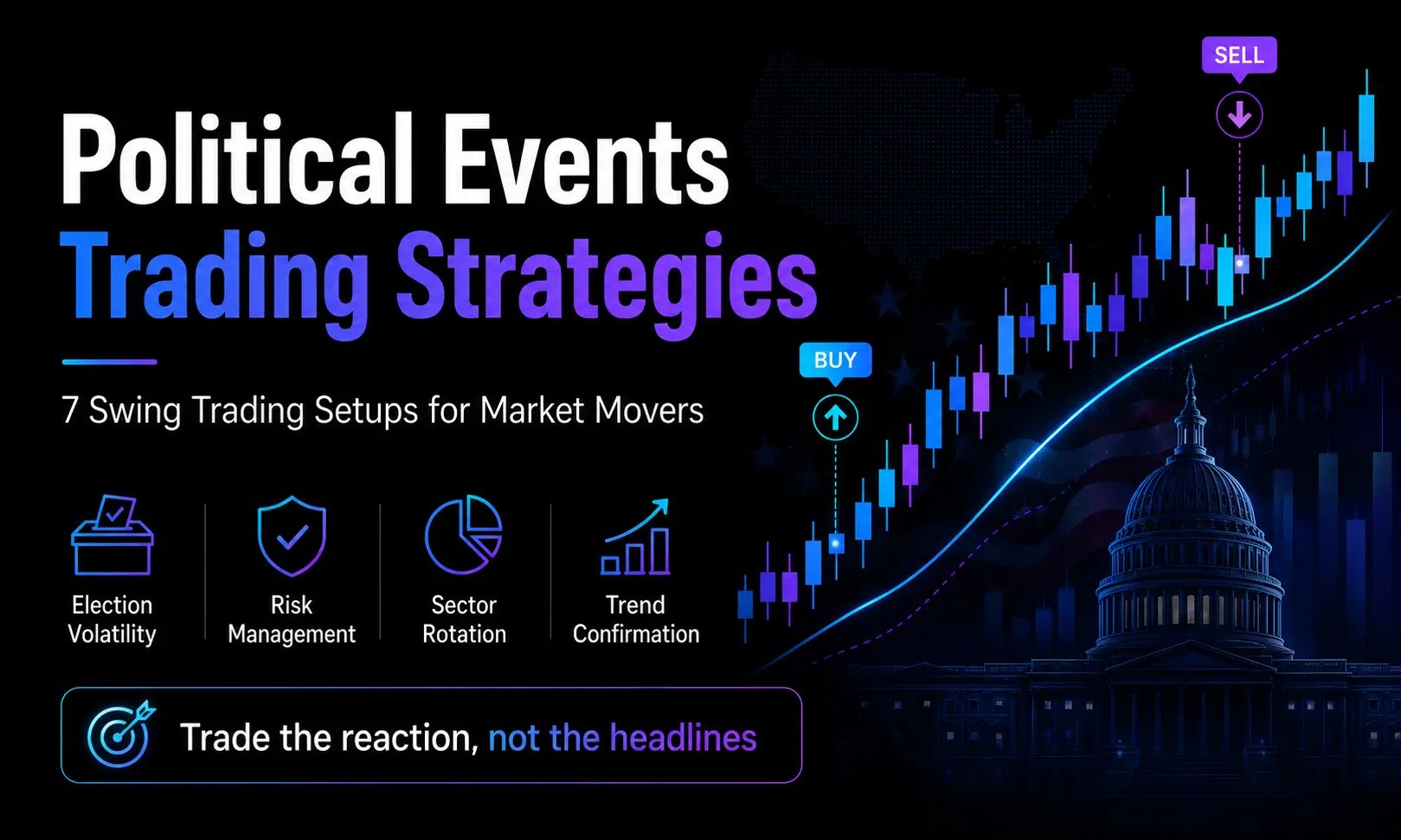
Political headlines can move markets in seconds, but the better opportunity often develops over several days. Elections, tariffs, sanctions, court rulings and geopolitical conflicts can change expectations for growth, inflation, interest rates and corporate profits. For U.S. traders, these events can create swing setups in stocks, ETFs, currencies, bonds and commodities.
The goal is not to predict every political outcome. It is to identify the exposed assets, wait for price confirmation and control overnight risk. Swing trades commonly last from a few days to several weeks, making them suitable for political themes that need time to spread through global markets.
What Makes a Political Event Tradable?
A political event becomes a market mover when it changes an asset’s expected value. A tariff may pressure import-heavy retailers while helping selected domestic producers. A conflict that threatens energy supply can lift crude oil and energy shares. An election may affect healthcare, defense, banks or technology through expected policy changes.
The headline alone is not the signal. Markets trade the difference between what happened and what was already priced in. A dramatic result may produce only a small move when traders expected it, while a policy detail can begin a larger trend when it changes earnings or interest-rate expectations.
1. Trade the Post-Event Breakout
Before a scheduled election, ruling or policy announcement, mark support and resistance on the daily chart. Wait for price to close outside that range with stronger volume.
A close above resistance can support a long trade. A close below support may support a short trade or inverse-ETF setup. Place the stop back inside the old range, where the breakout idea becomes weaker.
This approach works best when the event creates a clear change in expectations rather than a one-day emotional spike.
2. Enter on the First Pullback
The first market reaction is often too fast for a sensible entry. Instead of chasing a large opening gap, wait for price to return toward the breakout level, a short moving average or the midpoint of the news candle.
For example, suppose an energy ETF jumps after a political conflict threatens oil supplies. A two-day pullback that holds support may provide better risk and reward than buying the first surge.
The same idea works in falling markets. After a politically exposed sector breaks support, a weak rebound toward the old support level may create a possible short setup.
3. Follow Sector Rotation
Political developments can also affect major currency pairs, particularly when they change expectations for U.S. trade policy, interest rates or global risk sentiment.
Tariffs may benefit some domestic manufacturers but hurt businesses that rely on imported parts. Higher defense spending may support government contractors, while drug-pricing rules can pressure parts of the healthcare industry.
Use liquid U.S.-listed sector or industry ETFs when the policy effect is broad. Compare the sector with the S&P 500. A group that continues outperforming after the headline is more useful than one rising only because the entire market is higher.
4. Use a Relative-Strength Pair Trade
When the market’s overall direction is unclear, consider trading the difference between likely winners and losers.
A trader could go long a sector expected to benefit from a new policy and short a related sector facing higher costs. This reduces dependence on whether the entire stock market rises or falls.
Confirm that the long side is gaining relative strength while the short side is failing at resistance or making lower lows. Keep the two positions reasonably balanced and consider their different volatility levels.
5. Confirm the Story Across Markets
Political risk often appears in several markets at once. A risk-off move may involve weaker equities, stronger Treasury prices, a firmer U.S. dollar, higher gold prices or rising oil, depending on the event.
IMF research has found that major geopolitical risk events can weigh on stock prices and raise sovereign risk premiums, although the effects vary by country and event type.
Look for two or three markets supporting the same story. If oil rises sharply but energy stocks cannot hold their gains, traders may be questioning whether the move will last. Cross-market confirmation helps filter weaker setups.
6. Fade an Emotional Overreaction
Some political headlines create sharp moves that reverse when traders realize the economic effect may be limited, delayed or unlikely to become law.
A possible fade setup appears when price moves far from its recent average, trading volume jumps and the following session fails to continue the move.
Wait for confirmation instead of guessing the top or bottom. Confirmation might be a close back inside the previous trading range, a failed breakout or a lower high after a news-driven rally.
Use a smaller position because political stories can change without warning. This setup is strongest when fear or excitement drove the original move more than a measurable policy change.
7. Ride the Multi-Day Policy Trend
The best political swing trades are not always the fastest. Some policies affect earnings estimates, supply chains or interest-rate expectations over several weeks.
After the first breakout and pullback, price may continue forming higher highs and higher lows. Trail a stop below recent swing lows for long positions or above swing highs for short positions.
Consider taking partial profits near major chart levels while keeping part of the trade open as long as relative strength remains supportive. Exit when the trend breaks, the political story changes or the expected effect appears fully priced in.
Risk Rules for Political Swing Trading
Political trading carries gap risk because important news often arrives when U.S. markets are closed. FINRA warns that extended-hours trading can involve lower liquidity and higher volatility, potentially exaggerating price movements.
Never risk an amount that could seriously damage your account if the market opens beyond your planned stop.
Before entering, define the political catalyst, affected asset, entry signal, invalidation level and maximum holding period. Avoid oversized positions, illiquid options and trades based mainly on partisan conviction. A strong political opinion is not automatically a trading advantage.
Prediction-market contracts are different from stocks, ETFs, futures and currencies. The CFTC explains that customers may trade in and out of event contracts before settlement, but should examine contract terms, risks, fees and liquidity. U.S. regulation remains an evolving area, so users should also confirm platform and state availability.
Final Takeaway
Trading political events is less about forecasting politics and more about reading market expectations.
Start with a clear catalyst, identify the likely winners and losers, wait for price confirmation and keep risk small. The strongest opportunities often appear after the first headline, when a breakout, pullback or relative-strength shift shows where capital is actually moving.
FAQs
No. Markets react most strongly when an event changes expectations for corporate profits, inflation, interest rates, trade or regulation. An expected result may already be reflected in prices.
Sector ETFs, index futures, Treasury yields, the U.S. dollar, gold, crude oil and politically exposed stocks can react. The strongest market depends on how the event may affect the economy.
For many retail traders, waiting for confirmation after the result reduces prediction risk. Pre-election positions can suffer from price gaps, polling errors and sudden changes in expectations.
Some outcomes may be offered through regulated event contracts. However, access and legal treatment can vary. Check the platform’s regulatory status, settlement rules and availability in your state before trading.
Keep the position only while the catalyst and price trend remain valid. This may be several days or a few weeks. Use a time-based exit when the expected price movement fails to develop.