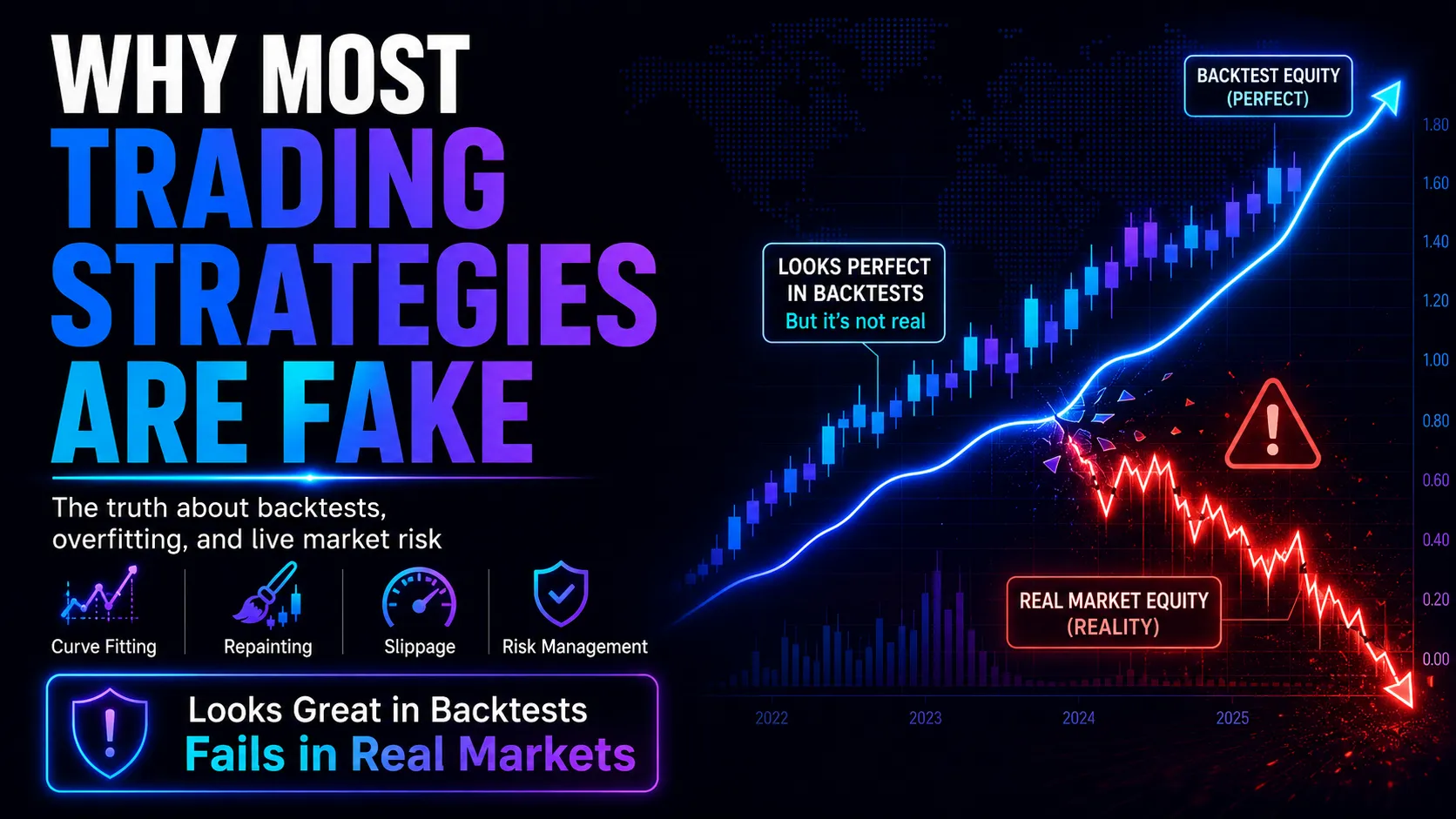
If you have spent enough time watching trading videos, testing indicators, or scrolling through trading communities, you have probably seen strategies claiming 80%, 90%, or even higher win rates. The charts look perfect. The backtests show steady profits. Yet once real money enters the picture, the results can look completely different.
So, why are most trading strategies fake?
In many cases, “fake” does not necessarily mean the strategy is a scam. It means the strategy has been optimized to look impressive on historical charts but has not been properly tested against real market conditions. Overfitting, unrealistic backtests, changing volatility, spreads, slippage, leverage, and trader psychology can turn an apparently profitable system into an unreliable one.
The real goal should not be finding a perfect strategy. It should be finding a trading approach that remains usable when the market stops behaving perfectly.
What Does a “Fake” Trading Strategy Actually Mean?
A fake trading strategy is often presented as if it can consistently generate profits with very little risk.
Common warning signs include:
- Extremely high advertised win rates
- Almost no losing trades in screenshots
- No discussion about drawdown
- No realistic stop-loss examples
- Results based only on one market period
- Backtests without spreads or trading costs
- Constantly changing indicators until past results look perfect
- Promises of guaranteed or consistent daily profits
A good strategy does not need to win every trade. In fact, some good forex strategies can remain profitable with a moderate win rate if their average winning trade is larger than their average loss.
That is why searching endlessly for the best forex strategy for consistent profits can become a trap. Consistency usually comes from the combination of a reasonable edge, disciplined execution, position sizing, and risk control—not from one magical indicator.
1. Backtests Can Make Almost Any Strategy Look Good
Backtesting is useful, but it can also create false confidence.
A trader may test dozens of indicators, timeframes, stop losses, take-profit levels, and entry conditions until one combination produces excellent historical results. The problem is that the strategy may have been fitted to past market noise rather than discovering a repeatable edge.
This is called backtest overfitting or curve fitting.
Research on backtest overfitting has shown that testing many alternative strategy configurations increases the chance of finding an impressive historical result simply by chance.
A strategy that performs beautifully between 2022 and 2025 might therefore struggle when conditions change in 2026.
Investor.gov also reminds investors that back-tested performance is hypothetical and does not represent actual trading performance. Investor.gov guidance on performance claims and backtesting
The lesson is simple: a good backtest is evidence worth investigating, not proof of future profitability.
2. Markets Keep Changing
Markets are not static.
A strategy built during a strong trend may perform poorly during consolidation. A scalping system designed for quiet sessions may struggle when volatility suddenly increases. Gold and forex markets can react sharply to inflation data, central-bank decisions, employment reports, geopolitical events, and changing liquidity.
This is known as a market regime change.
For example, an FVG trading strategy or Power of Three strategy might identify excellent setups during certain conditions, but neither should be treated as a guaranteed system.
The same applies to breakout strategies, moving-average systems, copy trading strategies, and even complex algorithmic or market-making strategies.
A strong trader asks:
“Under what conditions does this strategy work?”
A weak strategy is often marketed as though it works everywhere.
3. Backtests Often Ignore Spreads and Slippage
Imagine a backtest showing an average profit of five pips per trade.
That sounds attractive until real trading introduces:
- Bid-ask spreads
- Slippage
- Broker commissions
- Overnight financing
- Delayed entries
- Different liquidity conditions
If the strategy’s statistical advantage is already small, these costs can erase much of it.
This is especially important for short-term strategies where many trades are opened and closed.
A historical chart may show that price touched your exact entry and moved immediately toward take profit. In real trading, your order may fill slightly higher or lower.
The backtest says one thing.
The live account experiences another.
4. Traders Change the Strategy After Losing Trades
Sometimes the strategy is not the main problem.
The trader is.
Suppose your trading plan says:
- Risk 1% per trade
- Stop trading after three losses
- Never move a stop loss
- Take only setups that meet all entry rules
After two losing trades, frustration kicks in.
Risk becomes 2%.
Then 3%.
A mediocre setup suddenly looks “good enough.”
Eventually, one emotional trade creates a blown trading account.
This is why proper forex risk management tools are just as important as finding entries. Position sizing, drawdown limits, stop-loss planning, and trading journals can help traders evaluate a strategy without allowing one losing streak to destroy the account.
5. A High Win Rate Does Not Mean a Profitable Strategy
One of the easiest statistics to market is win rate.
“92% winning strategy” sounds much more attractive than “profitable strategy with controlled drawdown.”
But win rate alone tells you very little.
Consider two hypothetical systems:
| Strategy | Win Rate | Average Win | Average Loss |
|---|---|---|---|
| Strategy A | 80% | $50 | $250 |
| Strategy B | 45% | $200 | $75 |
Strategy A wins more often, but a few large losses can wipe out many winning trades.
Strategy B loses more frequently but may still have better expectancy.
Instead of asking only, “How often does this strategy win?” ask:
- What is the average win?
- What is the average loss?
- What is the maximum drawdown?
- How many trades were tested?
- Was it tested on unseen data?
- Does it survive different market conditions?
6. Indicators Can Repaint or Look Better in Hindsight
Another reason some strategies appear fake is hindsight.
On historical charts, entries can look obvious. Support held perfectly. The indicator caught the bottom. The crossover appeared just before the trend.
Live markets are much messier.
Some indicators can also recalculate or “repaint” as new price information arrives. That can make historical signals appear cleaner than they actually were at the moment a trader had to make the decision.
This is especially important when evaluating trading systems sold through screenshots or short social-media videos.
Never evaluate a strategy only by looking at its best historical examples.
7. More Complicated Does Not Mean More Profitable
Many traders assume sophisticated strategies must be better.
They combine:
RSI + MACD + moving averages + Fibonacci + FVG + order blocks + liquidity + volume + several confirmation indicators.
Eventually, the chart becomes so filtered that the strategy perfectly explains historical movement.
But every additional rule creates another opportunity for curve fitting.
Some of the best forex strategies are actually relatively simple. They define:
- Market condition
- Entry criteria
- Stop-loss placement
- Take-profit logic
- Position size
- Conditions where no trade should be taken
If you trade with limited capital, our guide to the best forex trading strategy for small accounts also explains why capital protection should come before chasing aggressive returns.
How to Tell Whether a Trading Strategy Is Realistic
Before trusting any strategy, ask these questions:
Was it tested over enough trades?
Twenty winning trades prove very little.
Was it tested on unseen data?
Out-of-sample testing helps determine whether a strategy was simply optimized for one dataset.
Are spreads and slippage included?
A realistic test should account for actual trading conditions.
What happens during losing streaks?
Every strategy will eventually experience losses.
Does performance depend on one pair or one year?
Extreme sensitivity can indicate overfitting.
Are risk and drawdown clearly disclosed?
Profit screenshots without risk statistics tell only half the story.
The same questions should apply whether you are testing manual setups, robots, signal services, or AI trading strategies for forex traders.
Stop Looking for a Perfect Strategy
The biggest mistake traders make is jumping from one strategy to another after a few losses.
Today it is price action.
Next week it is FVG.
Then ICT.
Then a trading bot.
Then copy trading.
This cycle never allows enough data to determine whether the original system actually had an edge.
A better approach is to choose a clearly defined setup, test it across a meaningful sample, calculate expectancy and drawdown, forward-test it under realistic conditions, and apply strict risk management.
A trading strategy should be treated as a framework for making decisions—not a machine that prints money.
Final Takeaway
So, why are most trading strategies fake?
Usually, it is because the performance traders see online is very different from what happens in live markets. Curve fitting, unrealistic backtests, changing market conditions, spreads, slippage, leverage, poor risk management, and emotional decisions can all destroy an impressive-looking strategy.
There is no trading method that wins all the time.
Instead of asking for the “perfect strategy,” focus on whether a strategy has logical rules, realistic testing, controlled risk, and the ability to survive losing periods.
And if you use external analysis or forex trading signals, treat them as decision-support tools rather than guaranteed trade outcomes. Understand the setup, check the risk, and make sure each trade fits your own trading plan.
FAQs
You make money in forex by buying a currency pair when you expect the price to rise or selling it when you expect it to fall. The hard part is doing it consistently. A tested strategy, strict risk management, small position sizes, and patience matter far more than chasing quick profits.
Start by learning one simple setup, practice it on a demo account, and risk only a small percentage of your capital per trade. Profitable forex trading usually comes from repeating a small edge over many trades—not from trying to win every trade or make money every day.
Take Profit Trader is a futures prop firm, so it does not use a simple forex-style leverage ratio such as 1:50 or 1:100. Your effective buying power is controlled mainly by the maximum number of futures contracts allowed for your account size. For example, its current rules allow up to 3 contracts on a $25K account and 6 contracts on a $50K account, with higher limits on larger accounts.
Because futures are naturally leveraged products, traders should pay close attention to contract value and the firm's trailing drawdown limits rather than just the headline account balance.
If you mean financial trading, forex is one of the easier markets to start learning because major currency pairs are liquid and there is plenty of educational material available. Start with one or two major pairs, learn price action, stop-loss placement, position sizing, and risk management before moving into gold, futures, crypto, or more advanced strategies.